
We close your first two
clients with you.
You never build the delivery.
We close your first two clients with you on done-for-you cold email and LinkedIn, then hand the wheel to your operator. You keep the retainers. One system, one fixed cost per client, and the delivery was never yours to build.
Watch the system run.
The onboarding, the signal-driven lists, the sending, and the inbox that answers and books. This is the delivery you would otherwise be building.
Outbound is easy to sell.
It's brutal to deliver.
The pitch lands in one call. Everything after that is the hard part, and it's the part nobody quotes for properly, because until you've run it, you don't know what it takes.
Fulfillment
Outbound sells itself. Then it has to be delivered. Most agencies quote it, win it, and discover they've signed up to run infrastructure they don't have: domains, mailboxes, warmup, lists, enrichment, sending, and an inbox that has to be answered the same day.
Costs that move
Eight to twelve tools, each billing per seat, per credit, or per lookup. That's a margin you can't quote with confidence and a number that changes every month, which means the retainer you signed in January isn't the retainer you're delivering in June.
Management overhead
Every new client multiplies logins, domains, mailboxes, and places something can silently break. Nobody notices the mailbox that stopped sending until the client asks why the meetings dried up.
The system runs most of it.
Not all of it.
Some manual engagement is required, and you should know exactly where before you apply, not after you sign. Here is the honest split.
Minutes a day, not a full-time seat. The meetings go to your client's calendar and your client takes them, unless the campaign is for your own agency.
The system does the work.
Your operator touches it four times.
Once to sign off on onboarding, then three places in the pipeline that a human owns. Everything in blue is the system. Everything in amber is your operator, and there is nothing else.
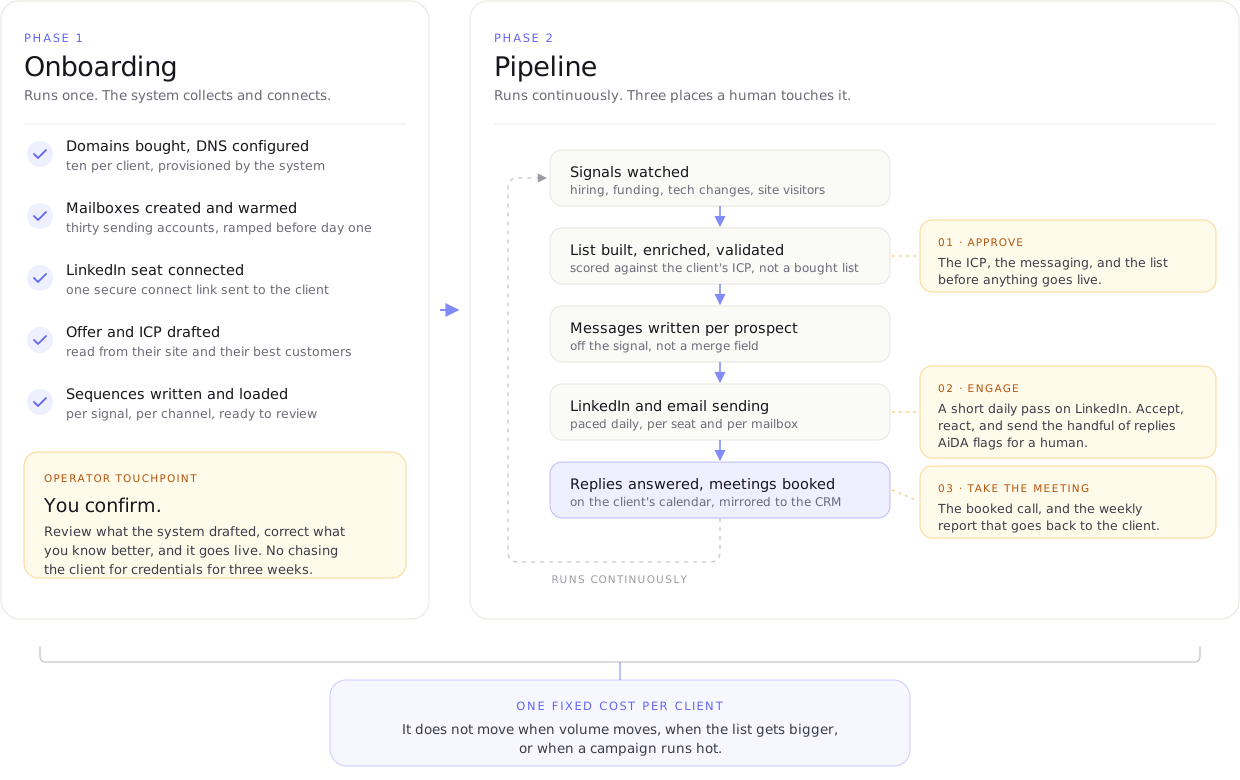
The onboarding is the
fulfillment pain.
Ask anyone who has delivered outbound for a client what actually kills the first month. It isn't the campaign. It's the three weeks before the campaign.
You chase the client.
Domains. DNS access. Credentials nobody can find. ICP detail that comes back as "anyone who needs our service." Case studies that are somewhere in a Drive folder. A calendar link that turns out to be the wrong calendar. Then a second round of chasing because half of it arrived incomplete.
Weeks of back and forth before a single message sends, and you're already being paid for a service that hasn't started.
The system provisions, connects, and drafts.
Domains bought and DNS configured. Mailboxes created and warming. One secure connect link for the LinkedIn seat. The offer and the ICP read off the client's own site and their best existing customers. Sequences written per signal and per channel, sitting there ready.
The client confirms. That's their whole job in onboarding.
Bought and configured, not requested.
Domains, DNS records, and thirty sending mailboxes are provisioned and warmed by the system. Nobody emails the client asking for registrar access.
One link, one click, one time.
The client connects their LinkedIn through a single secure link. No password handoffs, no shared logins, no "can you send me the 2FA code."
Drafted from what's already public.
Their site, their positioning, and their best current customers become the first draft of the ICP and the offer. Confirming a draft takes ten minutes. Filling in a blank questionnaire takes three weeks.
Written before the kickoff call ends.
Per signal, per channel, in the client's language and loaded into the system. Your operator reviews and edits. Nobody starts from a blank page.
Quote a retainer with
fixed cost of goods.
This is the part that decides whether an outbound division is a business or a treadmill. Not the size of the cost. The shape of it.
A stack that bills per seat, per credit, per lookup.
Every tool meters something different, and every one of them scales with activity. Send more, pay more. Build a bigger list, pay more. Run a campaign hot for a week because it's working, pay more.
Margin becomes a number you find out at the end of the month instead of one you set at the start.
One fixed cost per client.
It does not change when volume changes, when a list gets bigger, or when a campaign runs hot. Domains, mailboxes, contacts, signals, enrichment, validation, sending, and the AI setting appointments all arrive as one line.
You quote your retainer knowing exactly what sits underneath it, in month one and in month twelve. Your agency's first 90 days on the platform are already covered by the payment that built it.
Which is exactly the conversation the call is for: your retainer, your book, the cost underneath it, and what's left. With real figures, against your numbers.
Apply for the call →LinkedIn is live in
the first week.
Speed to first activity is the number that matters, because it's the one the client can see. From there we work the pipeline together until your first two clients are closed and your operator has the wheel.
Week one: the seat connects and LinkedIn starts sending.
Domains and mailboxes provision in the background while LinkedIn goes live, because LinkedIn doesn't need warmup and email does. First activity in days, not after a warmup window.
Your operator: confirms the ICP and the drafted messaging. That is the whole job in week one.
The first couple of weeks: conversations start.
Replies come in and get answered. Signals sharpen the list as real responses tell us who's actually in market. Email joins once the mailboxes have finished warming.
Your operator: handles the flagged replies, watches how the AI answers the rest, and learns the inbox by using it.
Then we work the pipeline together.
We're on the calls with you. We refine the offer against what the market says, tighten the pitch, and close. Two clients signed is the milestone, and we stay on up to five deals if you need more help getting there. Those two closes are what cover the remaining two payments, so we aren't finished until they're signed.
Your operator: sits in, runs the day to day, and by the second close is doing it without being asked.
Handoff: the wheel goes to your operator.
The system keeps delivering at the same fixed cost per client, and the recurring revenue was yours the whole time. Every client you add after the first few is yours at your price. What ends is us being in the room, which is the whole point.
Your operator: owns it. Approvals, engagement, meetings, and the weekly client report.
You make one.
That is the launch. We keep the setup fee on the two we close; you keep the monthly revenue. Every client you close after that is yours end to end, setup fee included.
Everything one client
needs, and what it
would cost you.
This isn't a feature list. It's the cost of goods for delivering outbound to one client. Priced separately, it's ten invoices to reconcile every month. Here it arrives as one line, and it does not move when the volume does.
Who this is for,
and who it isn't.
Disqualifying properly is the whole point of an application. A build that goes badly costs us more than a sale is worth, so read the right-hand column first.
Retainers in place and trust already earned. Outbound is the easiest thing you'll ever upsell into a relationship that's working.
An account manager, a VA, a junior hire, or you. It is minutes a day, not a job req you haven't opened, and it cannot be someone brand new to agency work.
Clients who sell to businesses, or B2B logos you want to go win yourself. A nameable buyer is what outbound needs.
We close with you, not instead of you. Your relationships open the door; we run the conversation and your operator learns it by being in the room.
One payment up front, and it isn't a token amount. Agencies that back their own division with real money are the ones these builds work for. That's not a coincidence, it's the pattern.
The system runs most of the activity, not all of it. Someone still has to sign off on lists and messaging and weigh in on the replies AiDA flags. With nobody to do that, the build underperforms and we both lose.
The first payment is required, and it's the filter. If it has to come out of revenue the division hasn't earned yet, the timing is wrong, and we'd rather tell you that than take it.
Two of the three payments are covered by clients that have to actually get closed, and closing them needs your name on the introduction. If you won't offer this to your own book, there is nothing for either of us to close.
Home services are usually a yes, not a no: plenty of roofers, HVAC firms, and cleaners want commercial accounts, and property managers and facilities leads are a real ICP we can build a list from. The no is a client who sells to consumers and nothing else. There is no company-shaped buyer to prospect, and that isn't a platform limitation, it's an absence of a list.
Before you apply.
Watch the walkthrough,
then apply.
The next page has the walkthrough and the full pricing: what you pay up front, what the per-client cost is, and how the first two closes cover the rest. Watch it, then apply if it fits.
Watch it and apply →Why there's an application
We only run a handful of builds at a time, because our team is in each one closing deals, not just the platform running in the background. The application tells us whether your book and your operator fit before either of us spends a call on it.
What's on the next page
The walkthrough, and every number: the up-front payment, the per-client cost, and how the two closes we run cover the rest. You'll know the price before you fill in a single field.
If it's a no
You'll hear it, with the reason. A build that goes badly costs us more than a sale is worth.